People make this sound more complicated than it is.
In DTF printing, single-side DTF film and double-side DTF film are not two completely different products. The main difference is not about where you print. It is about how the film handles while it moves through the printer.
That matters more than some buyers expect. A film can look fine at the start of a job and still create problems later. Long runs make those problems easier to see.
And one point needs to be clear from the beginning: double-side DTF film does not mean both sides are printable.
What is single-side DTF film?
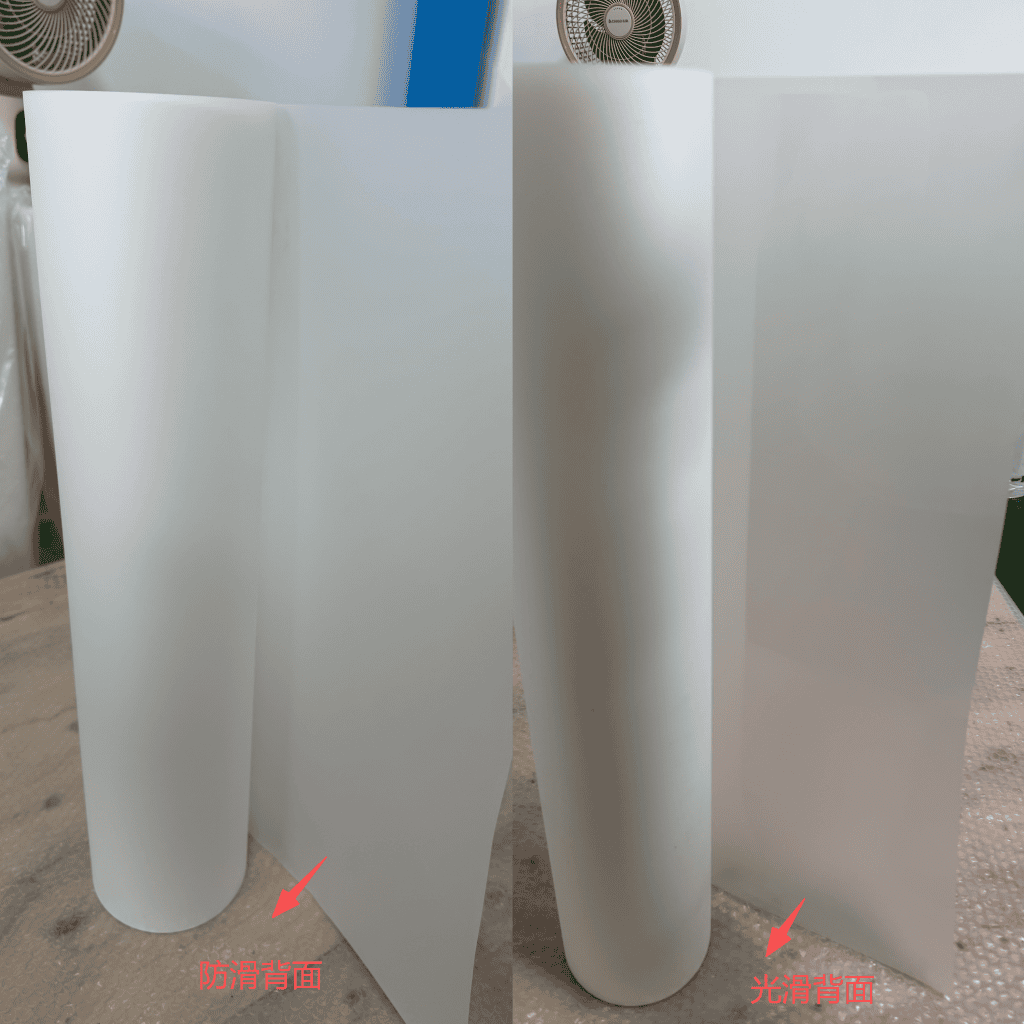
Single-side DTF film is the standard version used in a lot of shops. It has one coated side for printing and one smooth back side.
That is the setup most people already know. Print on the coated side, keep the smooth side on the back, and run the job.
If your machine feeds well and your output stays consistent from the first section to the last, single-side film is usually enough. There is no reason to turn a simple choice into a complicated one.
A stable printer does not always need a special film structure. Sometimes the standard option is the right one because it already works.
What is double-side DTF film?
This is where the naming causes confusion.
Double-side DTF film still has only one printable side. You are not printing on both sides. The printable surface is on the front, just like with single-side film.
The difference is on the back. Instead of being completely smooth, the reverse side has a matte or anti-slip treatment. That extra texture gives the film more grip while it passes through the printer.
So when suppliers talk about double-side DTF film, what they usually mean is a film with one printable side and one treated back side designed to improve handling. That is also why many people call it anti-slip DTF film.
Why the anti-slip back side matters
The benefit usually does not show up in the first few prints.
It shows up when the job gets longer, the speed gets higher, or the machine is not feeding as cleanly as it should. That is when small inconsistencies start becoming visible. A little slip here, a little drift there, and by the end of the run the output is no longer lining up the way it did at the beginning.
That is what anti-slip film is trying to help with.
The back side creates more friction, so the film moves more steadily through the system. In real production, that can mean better tracking, more consistent spacing, and fewer surprises on longer runs.
Not every shop needs that extra help. But shops that struggle with feeding issues often notice the difference quickly. For higher output and larger layouts, the 60cm × 100m DTF film roll is widely used.
What double-side DTF film does not do
Some buyers expect too much from it.
Double-side DTF film does not give you two printable sides. That idea causes a lot of ordering mistakes, especially for people new to DTF materials.
It also does not automatically solve peeling problems. If transfers are not peeling correctly, the cause is usually elsewhere. That kind of issue is more often connected to peel type, curing, powder, heat press temperature, pressure, or timing.
If you’re deciding peel type, this peel type guide explains the differences.
So yes, anti-slip DTF film can improve feeding stability. No, it is not a shortcut for fixing every issue in the process.
When single-side DTF film is usually the better choice
A lot of shops are perfectly fine with single-side DTF film.
If you mostly run short to medium jobs, your machine feeds consistently, and you are not seeing gradual alignment drift, the standard film is often all you need. It is simpler, familiar, and easier to keep as your baseline spec.
There is also a practical reason not to change things without a real problem. Once a workflow is stable, adding a different film type just because it sounds better is not always useful. Better on paper does not always mean better for your setup.
If the printer is already doing its job, keep it simple.
When double-side DTF film is worth testing
This is where double-side DTF film becomes a practical choice instead of just a product description.
If the film slips during feeding, even slightly, that is one sign. Maybe the tracking is not completely smooth. Maybe the roll movement feels uneven. Maybe you do not notice a problem right away, but the print tells the story later.
Another common sign is drift during longer runs. The first section looks clean, but after several meters the alignment is not as tight as it was at the start. That is exactly the kind of situation where anti-slip DTF film may help.
Higher print speeds can also expose feeding issues faster. A setup that looks fine at one speed may become less reliable when production moves faster.
Humidity is another factor. Some shops notice that film behavior changes on damp days. Feeding becomes less predictable, especially during longer jobs. In that kind of environment, a matte or anti-slip back side can make the process more forgiving.
How to tell whether you actually need anti-slip DTF film
The easiest way is to stop guessing and test it.
Run a longer print using the same file and your normal settings. Check the output near the beginning, then compare it to a later section of the same run. Look closely at alignment and spacing.
After that, do the same test under harder conditions. Print a bit faster. Or compare results on a more humid day if that is when your feed problems usually show up.
If the pattern repeats and the film starts drifting later in the job, that is useful information. At that point, trying double-side anti-slip DTF film is a practical next step, not just a theoretical upgrade.
Common myths about single-side vs double-side DTF film
One myth is that double-side DTF film automatically means higher quality.
It does not. It simply means the film has a different structure. Overall quality still depends on how well the film is manufactured, how consistent the coating is, how stable the batches are, and how the rolls are stored and handled.
Another myth is that anti-slip film will solve transfer release problems. Usually it will not.
And the biggest misunderstanding is still the most basic one: double-side does not mean dual printable sides.
How buyers end up ordering the wrong film
Usually because the wording is too vague.
If someone says they want “double-side film” but does not explain what they actually need, there is room for misunderstanding. One person is thinking about feeding stability. Another is thinking about printable surfaces. That is how the wrong material gets ordered.
The better approach is to state the actual spec. Confirm the printable side, the back-side treatment, the peel type, the finish, and the size.
If what you want is better feeding, say so directly. Ask for one printable ink-receptive side and one anti-slip or matte back side. Clear specs prevent avoidable mistakes.
Storage affects feeding too
This part gets overlooked.
Film that has absorbed moisture does not always behave the same way as film stored in a dry, controlled space. Temperature swings and humidity changes can affect handling, and sometimes the symptoms look like a machine problem when the film is part of the issue.
That applies to both single-side DTF film and double-side DTF film.
Good storage will not fix a bad setup, but poor storage can definitely make a good setup look worse. Keeping film sealed, dry, and away from big environmental changes helps maintain more consistent feeding.
For a simple checklist, see our storage guidelines for film, ink, and powder.
Final thoughts
The difference between single-side and double-side DTF film is not about having two printable sides.
Single-side DTF film has one printable coated side and one smooth back side. It is the standard choice, and in many production environments it works just fine.
Double-side DTF film also has only one printable side. The back side is treated with a matte or anti-slip finish to improve grip and help the film feed more steadily through the printer.
That is the real distinction.
So when choosing between them, do not focus on the name. Focus on what is happening during production. If feeding is already clean and stable, single-side DTF film is usually enough. If long runs, faster speeds, or humid conditions are exposing slip and alignment drift, double-side anti-slip DTF film is worth considering.